


The History of The Greyhound: How Kew's Favourite Pub Grew Up with the Village
Every pub has a story. The good ones have several.
The Greyhound sits at 82 Kew Green in the London Borough of Richmond upon Thames, on a stretch of village green that has barely changed in outline since the eighteenth century. The houses around it are Georgian. The trees are older still. And the pub, in one form or another, has been here for most of it.
This is the story of how The Greyhound came to be what it is today.
Kew Green: The Setting That Shapes Everything
To understand The Greyhound, you first have to understand Kew Green.
Unlike most of London, Kew didn't grow organically outward from the city. It developed as a village in its own right, shaped largely by two forces: the river and the Crown. The Thames made it accessible and prosperous. The Royal family made it fashionable.
Kew Palace, the modest but historically significant royal residence on the edge of what would become the Royal Botanic Gardens, attracted courtiers, botanists, and wealthy Londoners seeking a retreat from the city. By the mid-1700s, Kew Green had become one of the most desirable addresses in the country, its handsome townhouses occupied by scientists, artists, and members of the royal household. The Green itself is recorded in a Parliamentary Survey of Richmond as far back as 1649, described as "a piece of common or uninclosed ground called Kew Green, lying within the Township of Kew, conteyning about 20 acres."
Where fashionable people gathered, they needed somewhere to eat, drink, and talk. That need is as old as civilisation, and it's part of what brought The Greyhound into existence.
The Origins of The Greyhound
The Greyhound appears in the Post Office Directory of Surrey as early as 1878, with a licensee named Charles Smith recorded at 82 Kew Green. Trade directories of this kind typically captured establishments that had already been trading for some time, so it is reasonable to place the pub's origins in the earlier Victorian period, if not before.
The name itself is telling. Greyhound was one of the most common pub names in England from the medieval period onward, associated variously with speed, nobility, and the hunting pursuits of the gentry. In a village with royal connections and wealthy residents, it was an apt choice.
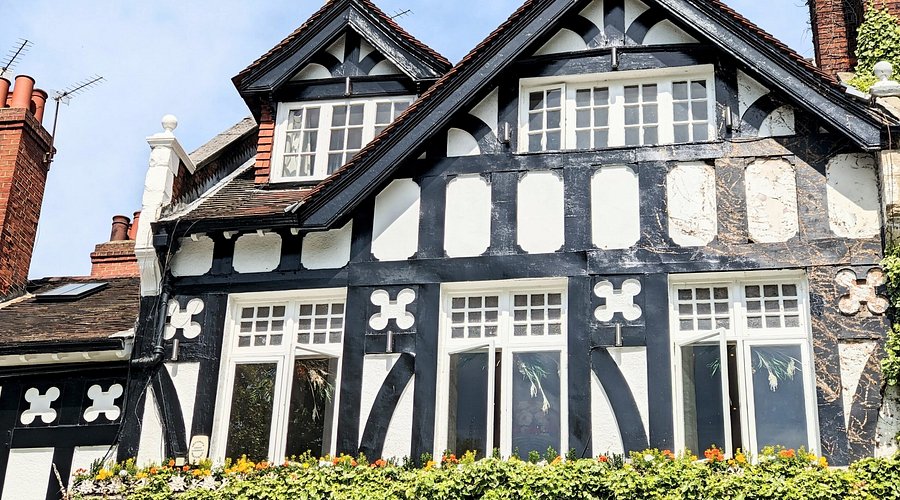
The building that stands today is a handsome Tudor-style structure, built over three storeys, with a pitched clay-tiled roof and a frontage that faces directly onto the Green. It is the kind of building that was designed to be noticed and to last, and it has done both.
The Pub Through the Centuries
The Victorian Era
Victorian Kew was a place of increasing civic pride. The Royal Botanic Gardens opened to the public in 1841, and visitor numbers grew steadily across the second half of the century. A pub on Kew Green was well placed to benefit. The railways arrived in the area by the 1860s, making Kew accessible from central London in minutes and bringing a new wave of day-trippers, families, and weekend visitors.
By 1878, with Charles Smith behind the bar, The Greyhound was an established part of the Green's social fabric. The pub would have served the full range of Kew life during this period: workers from the Gardens, residents of the Georgian townhouses, visitors arriving by train, and the cricketers who had been playing on the Green since the 1730s.
The Early Twentieth Century
By 1937, the pub's licensee was recorded in Kelly's Directory as A. Comfort, a name that, it's tempting to say, suited the trade well. The interwar years were a period of change for British pubs generally, as licensing laws tightened and the nature of the local shifted. The Greyhound, anchored on one of London's finest village greens, weathered those changes steadily.
The postwar decades brought further shifts to the British pub trade: keg beer, refurbishments, the gradual move toward something more welcoming to families and food. The Greyhound navigated those changes and came out the other side as a proper local, a place that served the community rather than just passing trade.
Recent Decades
The modern chapter of The Greyhound's story began around 2011, when the pub changed ownership and underwent renovation, refocusing its offer around quality food and drink in keeping with the independent gastropub model. A further refurbishment followed in March 2014, which opened up the ground floor and transformed the first-floor space into the dining room it is today: a proper room with views over Kew Green that has become one of the area's most sought-after spots for a Sunday lunch or a private event.
Today The Greyhound is an independent, family-run business, sourcing locally, cooking seasonally, and maintaining the kind of connection to its community that the best pubs have always had.
The Green Itself
The Greyhound's story is inseparable from Kew Green, which is one of the best-preserved village greens in London. Cricket has been played here since at least 1732, when a match between London and Middlesex took place on the Green. The Kew Cricket Club, which plays here to this day, is among the oldest in the country.
The churchyard of St Anne's, just across the Green, contains the graves of Thomas Gainsborough and Johann Zoffany, two of the greatest painters of the Georgian era, both of whom lived locally and would have known this corner of the village well.
It's the kind of place that makes history feel close rather than distant. Stand outside The Greyhound on a summer evening and you are, in a very real sense, standing in the same spot where people have stood for well over a century, doing much the same thing.
What Stays the Same
Pubs change. The beers on tap, the faces behind the bar, the food on the menu, the décor on the walls. All of it shifts across the decades.
But the best pubs retain something that doesn't change: a sense of belonging to their place. The Greyhound is a Kew pub in the fullest sense. It serves the people who live here, welcomes the people who visit, and sits on one of the most beautiful pieces of common land in London with a confidence that comes from knowing it has been here a long time and intends to stay.
That continuity matters more than most people realise. In a city that tears things down and starts again with remarkable regularity, a pub that has stood on the same green for well over a century is something worth preserving, worth celebrating, and absolutely worth visiting.
We'll raise a glass to that.
📍 The Greyhound, 82 Kew Green, Richmond, TW9 3AP